Repair first — replacement only where it is needed
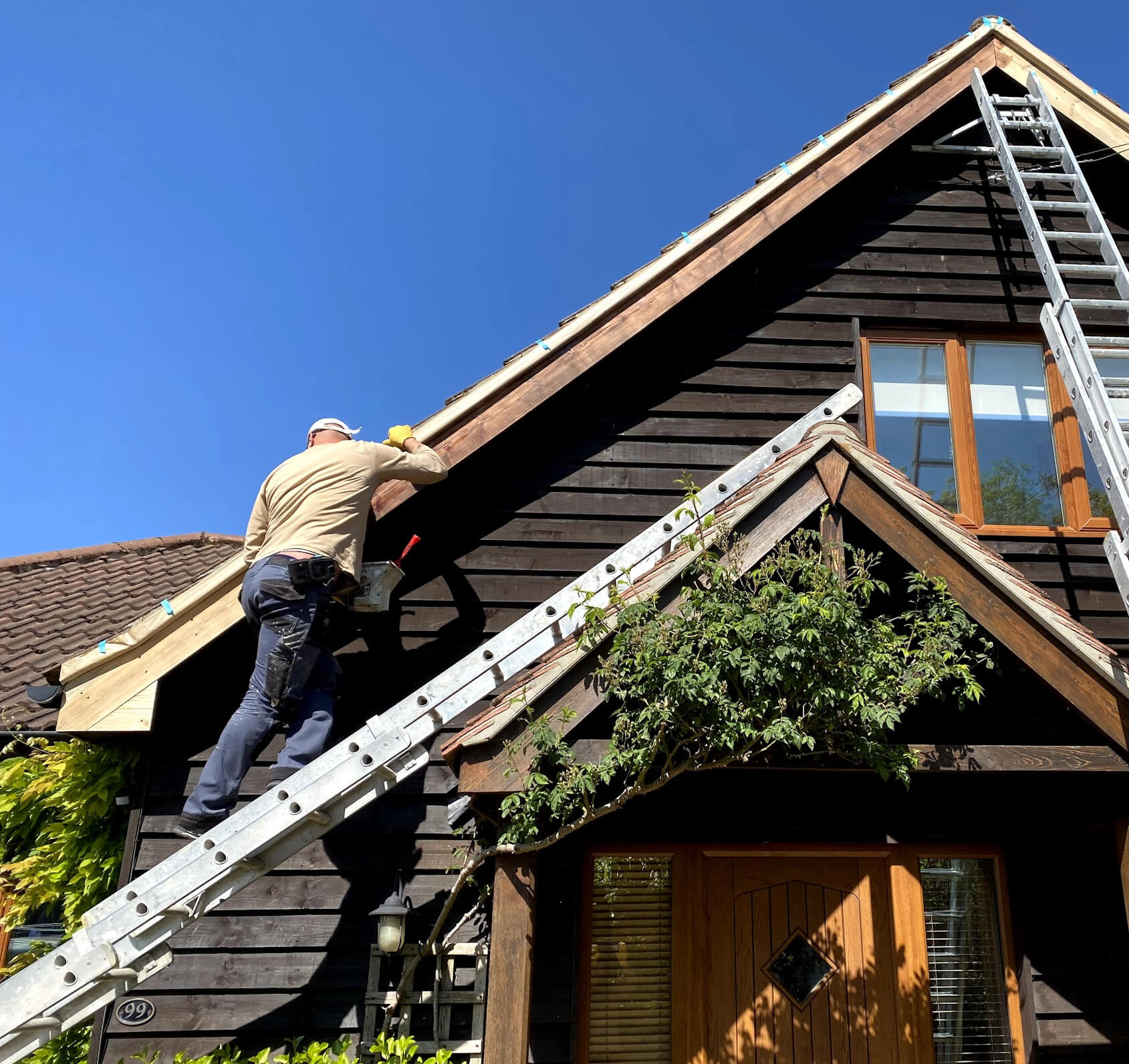
Most of the timber rooflines we look at across Cambridge, Norwich, Ipswich, Chelmsford and the towns between them do not need replacing. They need the wet ends cut out, the joints re-made, the paint film restored and the reason they got wet in the first place put right. That is what a fascia and soffit repair is, and it is where we started as a business: timber repair, done by people who understand how roofline timber fails, rather than a uPVC sales visit dressed up as a survey.
We do replace boards when they are beyond saving, and we fit uPVC when it is the right answer. But on a Victorian terrace in Cambridge, an Edwardian villa in Norwich or a 1930s semi in Bedford, a well-made repair keeps the profile the house was built with, costs a fraction of a full replacement and, painted properly, lasts as long as new timber would.
Cambridge houses were built to be repaired
Most of our repair work is in the city itself, on houses a century or more old: the Victorian terraces of Romsey, Petersfield and the Mill Road streets, the Edwardian villas off Hills Road and along the Chesterton and De Freville avenues, the Newnham and Castle Hill houses with their boxed eaves and moulded fascias. Boards like these were made from slow-grown softwood on sound rafters, and they fail at the ends and the joints, not along their length — exactly what a splice repair is for. In the conservation areas (Central, Newnham, De Freville, Chesterton, Mill Road and the rest) like-for-like repair needs no consent and is what the officer would rather see; some streets carry Article 4 directions that restrict a change of material on the front, one more reason to keep the original board. Terraces with no rear access are everyday work here: the front from a ladder or a pavement scaffold (we arrange the highway licence), the back through the house or with a neighbour’s agreement.
What we repair
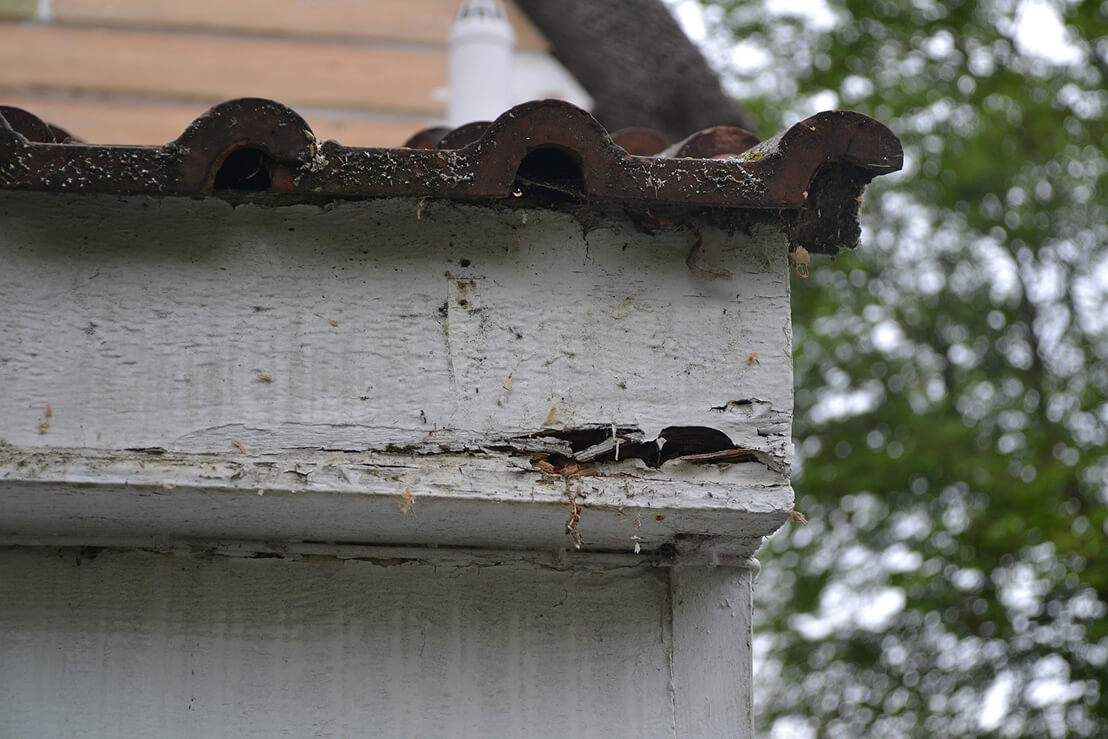
- Rotten fascia ends and joints — the corners and the joints between boards are where water sits and where rot begins. We cut back to sound timber and splice in new, using a scarf or half-lap joint that is glued, screwed and sealed, not butt-jointed and filled.
- Soft bottom edges — the lower edge behind the gutter gets wet every time the gutter overflows. A resin repair or a new bottom section restores the edge and the gutter fixing.
- Split, cupped and open-grained boards — long boards that have dried out and split can be consolidated, filled with a flexible two-part filler and repainted rather than replaced.
- Soffit boards — sagging, stained or holed soffits, including the ply and hardboard soffits fitted from the 1960s onwards, which we replace in sections with a vented board.
- Loose or missing sections — boards that have pulled away from the rafter feet, taking the gutter with them, are re-fixed into sound timber with new packers where the rafter ends have gone.
- Failed paint and stain — stripped back, primed and repainted with a flexible exterior system so the next repaint is a maintenance job, not a rescue.
- Bargeboards and finials — the same repairs on the gable ends; see bargeboard repair and replacement.
Restoration of traditional fascias and soffits
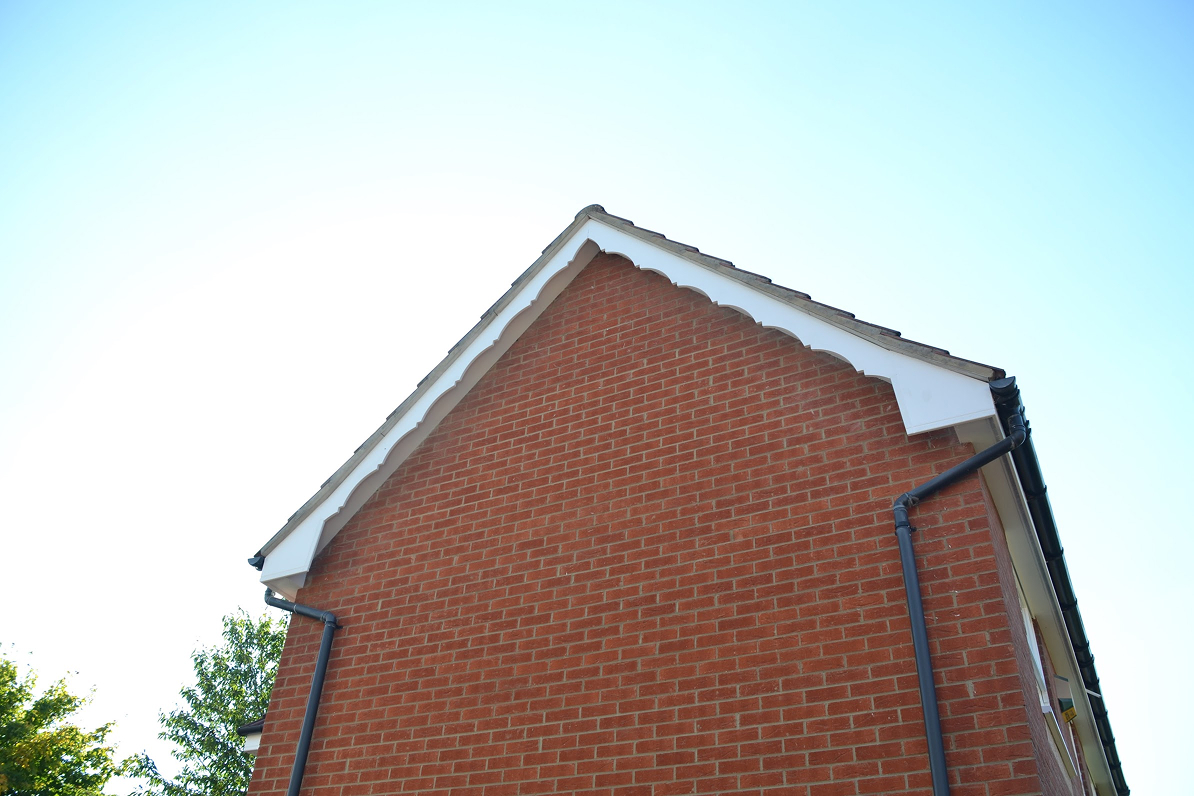
Older houses in this part of the country — the Cambridge and Norwich terraces, the Suffolk and Essex villages, the Georgian and Victorian stock in Bury St Edmunds, Saffron Walden and Woodbridge — were built with moulded fascias, boxed eaves, dentil courses and decorative bargeboards that a modern flat board cannot replace without changing the look of the house. Restoration means keeping that detail: stripping the accumulated paint, repairing the original timber, replicating any sections that are lost from the surviving profile, and finishing to a high standard. On listed buildings and in conservation areas it is usually the only approach the conservation officer will accept, and it is the one that keeps the value in the house.
Lamination with Tricoya
Some boards are weathered all over yet still structurally sound: the surface is checked and open-grained, the paint will not hold, but the timber is dry and the fixings are firm. Stripping a board like that out is wasteful, and repainting it alone will not last. Our answer is to laminate a Tricoya face onto the prepared board. Tricoya is an acetylated timber panel that does not take up water, so it does not swell, shrink or rot, and it holds paint far longer than softwood. The result is a new, stable, paintable surface that keeps the original board and its profile, done in a day rather than a week, and guaranteed against rot for decades.
How a repair visit works
- Survey from the ladder, not the pavement We probe every board with an awl along its length, check the rafter feet behind the soffit, look at the gutter falls and joints, and photograph what we find. You get the photographs with the quote.
- A written quote that separates repair from replacement Each elevation is listed with what is sound, what can be repaired and what has to come out, with a price for each, so you can see exactly what you are paying for and decide how far to go.
- Cut back, splice, consolidate Rot is cut back until the timber is dry and hard, new sections are jointed in with exterior adhesive and stainless fixings, and open grain and small losses are filled with a flexible two-part filler.
- Fix the cause A leaking gutter joint, a missing drip edge, a downpipe discharging onto the fascia — whatever wetted the board is put right at the same time, or the repair is wasted.
- Prime, paint, hand over New and repaired timber is primed on all faces before it goes up, then painted or stained to match. We leave the roofline clean and the gutters running, and tell you when it will next need looking at.
Not sure whether it is a repair or a replacement? Our guide to repairing versus replacing fascias and soffits sets out how we decide, and the signs of fascia and soffit damage to look for from the ground.
Why roofline timber fails in East Anglia
This is one of the driest corners of Britain, which lulls people into thinking timber lasts longer here. In practice the roofline sees the same water as anywhere else, because it comes from the gutter rather than the sky: every blocked outlet and dripping joint runs straight down the fascia. Add the flat, open fenland and coastal exposure that drives rain sideways under the eaves, hard winter frosts that open up paint on north-facing elevations, and the strong summer sun that bakes the south side, and softwood boards fitted in the 1960s to 1980s on the Peterborough, Milton Keynes and Basildon estates are simply reaching the end of their life. Our job is to give them a second one where that makes sense, and to tell you plainly when it does not.
Fascia and soffit repair across East Anglia
We repair rooflines throughout Cambridgeshire, Norfolk, Suffolk, Essex, Bedfordshire, Northamptonshire and Buckinghamshire — from Cambridge, Ely and Peterborough out to Norwich and King's Lynn, Ipswich and Bury St Edmunds, Colchester and Chelmsford, Bedford and Luton, Northampton and Kettering, Milton Keynes and Aylesbury. Send a couple of photographs with your postcode and we will tell you straight away whether it looks like a repair, and what it is likely to cost.